The summer before my junior year, I worked as a research assistant in the American studies department under Professor Roberto Saba, my major advisor. He was conducting research for an upcoming book on Americans who traveled to South America in the postbellum era.
As Professor Saba’s assistant, I’d be reading through travel books written by all sorts of people, from missionaries to navy wives. My goal was to examine how issues such as class, race and gender affected authors’ interactions with South Americans.
The Research Process
Over the summer, I scoured several databases—Google Books, the Library of Congress, and the Internet Archive—to find relevant material. It was often difficult to tell from a glance whether a travelogue would be useful. A book published in 1892 (after our 1890 cutoff date) might be about a trip taken in 1889, making it worthy of a closer look. In other cases, authors were more interested in discussing wildlife and personal musings than their interactions with locals. Therefore, I skimmed each travelogue before flagging it for further analysis.
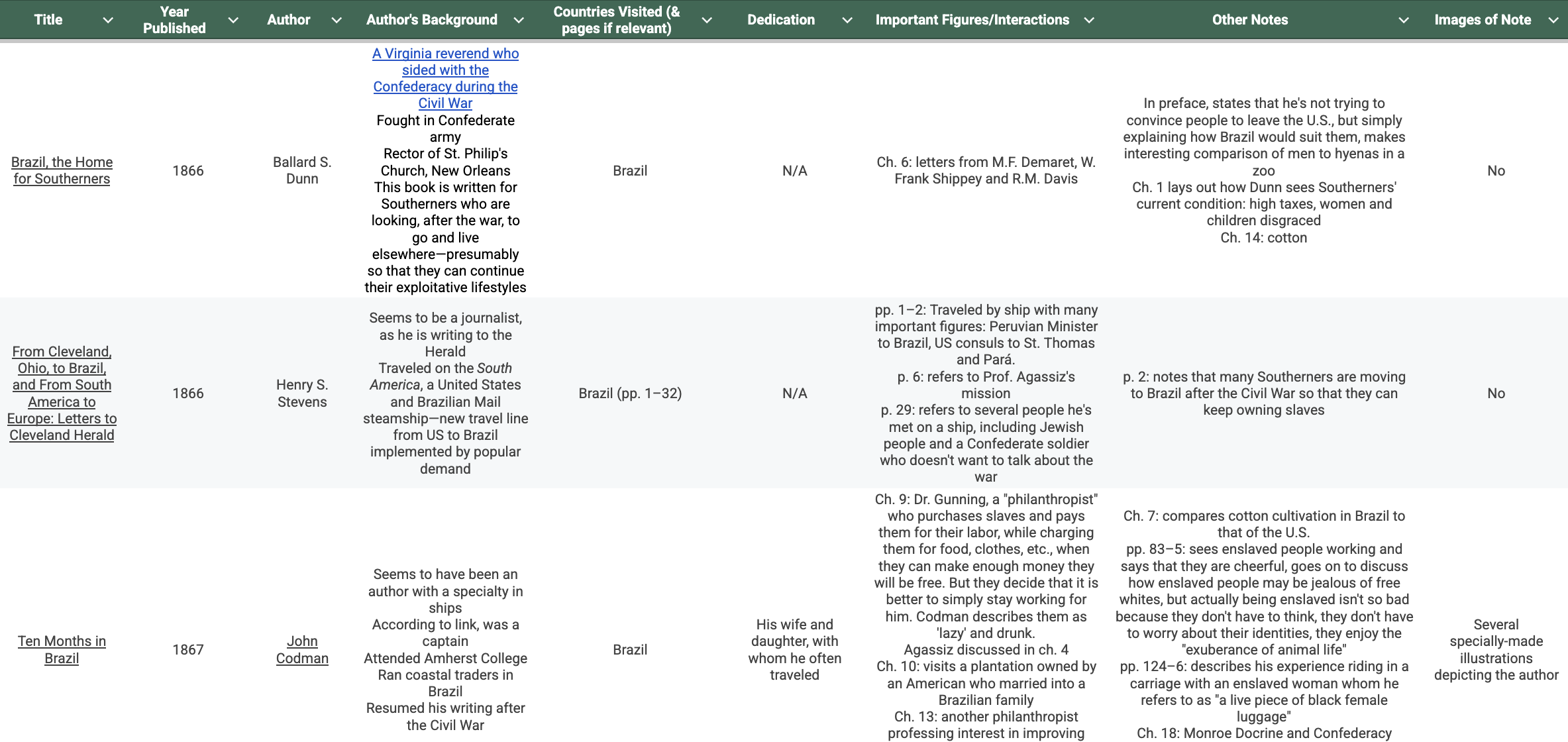
To help myself stay organized, I designed my own spreadsheet where I recorded key information about each travelogue: its publication date, its author and their affiliations, the places they visited, and people of note that they met. I also included a section for anecdotes that I found personally fascinating, such as an ex-Confederate’s musings on the state of the South and another author’s timeless question, “Why do mosquitoes exist?”
By the end of the summer, my spreadsheet—excluding other sources that didn’t fall within our time frame, but I still thought would be useful—spanned 9 rows and 27 columns worth of data.
Presenting my Findings
Once I’d made my spreadsheet, I was able to select the three travelogues that would be the most relevant to Prof. Saba’s research. After reading them in full, I designed a mind-map style visual guide that broke down each of the three travelogues by their key themes.
In each map, I sorted 15–20 of the book’s most interesting moments into different themed categories, such as “Race and Indigeneity,” “Cleanliness and Health,” and “Religion.” More often than not, a single passage fit into multiple categories, enabling me to make thematic connections within the text.
Making the mind maps allowed me to both reflect on the work I’d done over the summer and realize the thematic similarities between the three travelogues. Overall, I found the research both engaging and fulfilling, and I’m excited to see how it will be incorporated into Professor Saba’s book.
